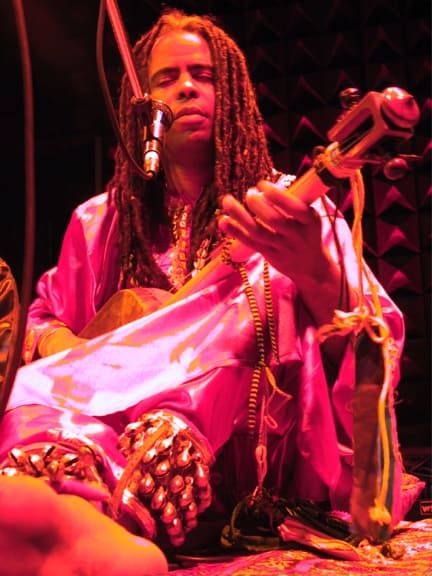
To understand Hassan Hakmoun, one must first understand Gnawa — not as a genre, not as a style, but as a living tradition that has survived slavery, colonization, urbanization, and globalization without ever losing its spiritual core. Gnawa is not music performed for entertainment. It is music performed for healing, for transcendence, for communion with forces that predate the modern conception of religion itself.
Origins: The Atlantic Passage
The Gnawa people trace their origins to the trans-Saharan and trans-Atlantic slave trades. Their ancestors were brought to Morocco from West Africa — primarily from the regions now known as Mali, Senegal, Ghana, and Nigeria — beginning as early as the 11th century and continuing through the 19th. These were not merely laborers but spiritual practitioners, carriers of West African animist traditions that would merge with Moroccan Sufism and Islamic mysticism to create something entirely new.
“Gnawa music is the sound of displacement finding its home. It is the voice of people who were torn from their land and, against all odds, built a spiritual universe in a new one.
The word “Gnawa” itself likely derives from the Berber word meaning “black people” or, in some interpretations, from the name of a West African kingdom. Either etymology underscores the tradition’s inextricable connection to Africa and to the Black diaspora in North Africa — a history that Moroccan culture has not always fully acknowledged, and which Hakmoun has worked tirelessly to bring to the forefront.
The Lila: Architecture of Trance
At the center of Gnawa practice lies the lila — an all-night healing ceremony that follows a precise ritual structure while remaining open to improvisation and spiritual spontaneity. The lila is not a concert. It is not a performance in the Western sense. It is a medical intervention, a spiritual cleansing, a communal act of devotion that can last from sunset to sunrise.
The lila operates on the principle that illness — whether physical, mental, or spiritual — results from imbalances in the relationship between the individual and the unseen spiritual forces that govern existence. Music is the medicine.
The ceremony proceeds through seven distinct sections, each dedicated to a different mluk — a category of spiritual entities that the Gnawa believe inhabit the world alongside humans. Each mluk has its own color, scent, rhythm, and melodic mode. The m’allem, or master musician, serves as both conductor and shaman, guiding participants through increasingly intense states of trance using the guembri’s deep vibrations and the qraqeb’s metallic clatter.
The Guembri: Instrument of the Spirits
The guembri — also known as the sintir — is unlike any other stringed instrument in the world. A three-stringed bass lute, its body is carved from walnut or fig wood and covered with camel skin. The strings are traditionally made from goat intestine, though modern players sometimes use synthetic materials. The instrument produces a sound that is simultaneously percussive and melodic, earthy and otherworldly.
“The guembri has a register that seems to bypass the ears and speak directly to the body. You feel it in your chest before you hear it in your head. This is not accidental — it is the instrument’s design, refined over centuries for exactly this purpose.
Hakmoun’s relationship with the guembri is the stuff of legend among Gnawa practitioners. Other m’allems speak of his tone with something approaching reverence — a depth and clarity that seems to come from somewhere beyond technique. In Gnawa, this is understood not as mere skill but as baraka, a spiritual blessing that manifests through the blessed individual’s work.
The Qraqeb: Steel Voices of Memory
If the guembri provides the lila’s foundation, the qraqeb — large metal castanets played in interlocking patterns — provide its nervous system. The qraqeb’s sharp, metallic clatter creates a polyrhythmic texture that is simultaneously complex and hypnotic, driving the ceremony’s escalating intensity. The instrument’s sound is often described as evoking chains — a sonic memory of the Gnawa people’s enslaved ancestors that has been transformed from a symbol of bondage into an instrument of liberation.
- The qraqeb are always played in pairs, held in both hands, creating interlocking rhythmic patterns that mirror the tradition’s West African roots.
- The instruments are traditionally forged from recycled metal — a symbolic transformation of industrial material into spiritual tool.
- Learning the qraqeb requires years of apprenticeship, as the interlocking patterns must become embodied to the point of unconscious mastery.
Preservation and Evolution: Hakmoun’s Dual Mission
In the modern era, Gnawa faces a paradox common to many traditional art forms: the very exposure that ensures its survival also threatens its transformation into something unrecognizable. As Gnawa has become a staple of world music festivals, a soundtrack for luxury hotels in Marrakech, and a feature of Moroccan cultural diplomacy, questions of authenticity and appropriation have become increasingly urgent.
Hakmoun has navigated these waters with remarkable deftness. His collaborations with Western musicians are never simple fusions in which Gnawa elements are diluted for mass consumption. Rather, he insists on the integrity of the tradition while demonstrating its capacity for dialogue with other musical languages.
Through the Hausa Gnawa Festival, Hakmoun has created a platform that brings these questions into productive tension. The festival’s programming deliberately juxtaposes traditional lila ceremonies with contemporary reinterpretations, scholarly conferences with late-night jam sessions, creating a space where preservation and innovation are not opposed but are understood as complementary aspects of a living tradition.
The Living Archive
Hassan Hakmoun’s body of work — five albums spanning three decades, countless performances across every inhabited continent, and now an international festival bearing his creative vision — constitutes a kind of living archive. Unlike the static preservation of museum collections or academic field recordings, Hakmoun’s archive breathes, changes, and responds to each new context it encounters.
In this, he embodies the paradox at the heart of Gnawa itself: a tradition born from displacement and trauma that has become, through the resilience and creativity of its practitioners, one of the most vital and spiritually potent art forms on Earth. The ancient voice of Gnawa speaks still, and in Hassan Hakmoun, it has found one of its most eloquent, passionate, and far-reaching interpreters.