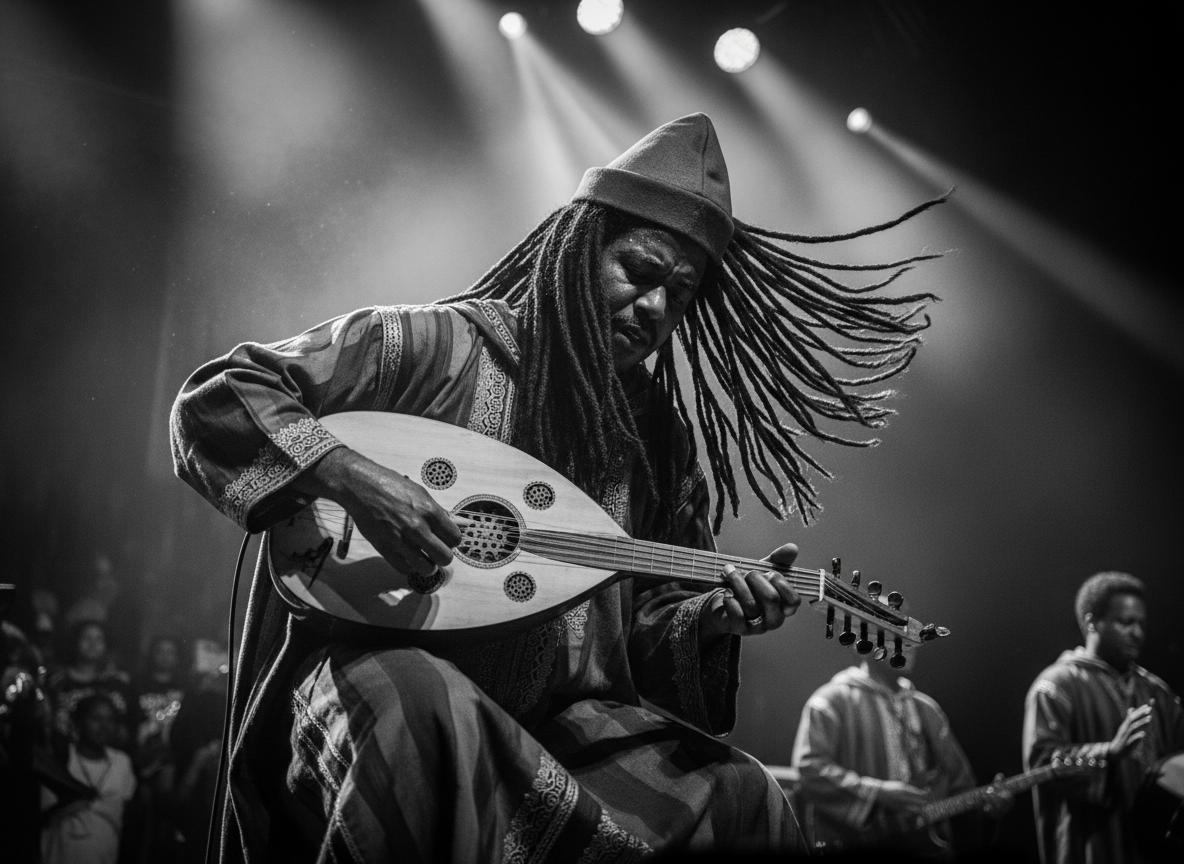
In the hands of a master, the guembri is not merely played — it is inhabited. The instrument becomes a medium, a translator between the visible world and the invisible realm of the mluk, the spirit entities that Gnawa tradition recognizes as the true force behind music, healing, and human destiny. To watch Hassan Hakmoun play the guembri is to witness something that looks less like a musical performance and more like a conversation with an unseen presence.
The Body: Craft and Symbol
The guembri’s body is carved from a single piece of wood — traditionally walnut or fig, though olive wood is also used. The artisan hollows the body with precise care, creating a resonant chamber that will amplify the instrument’s uniquely deep voice. Over this chamber, camel skin is stretched and secured, creating a drum-like surface that contributes to the instrument’s percussive quality.
“Every guembri has a soul. You cannot mass-produce a guembri any more than you can mass-produce a voice. The wood, the skin, the maker’s hands — all of these leave their mark on the instrument’s character.
The symbolism embedded in the guembri’s construction is not accidental. The camel, in North African culture, represents endurance, spiritual journeying, and the capacity to survive in harsh conditions. Stretching camel skin over the instrument’s body is understood as a way of imbuing the guembri with these qualities — the capacity to sustain long ceremonies, to travel across spiritual and physical distances, and to endure.
The Three Strings: Voice, Breath, and Spirit
The guembri has three strings, tuned in a relationship that creates both the fundamental pitch and the rich harmonic overtones that give the instrument its distinctive sound. The strings are plucked with the thumb and index finger of the right hand while the left hand presses against the neck to change pitch. This technique — thumb for the lower strings, index finger for the higher — creates a rolling, almost vocal quality that has led many listeners to describe the guembri as “singing” rather than “playing.”
The three strings are often interpreted as representing body, soul, and spirit — the three dimensions of human existence that Gnawa seeks to harmonize through the lila ceremony. When the guembri speaks, it speaks on all three levels simultaneously.
Hakmoun’s technical approach to the guembri is both deeply traditional and subtly innovative. He uses a brass ring on his plucking thumb — a technique passed down through generations of m’allems — which adds a bright, metallic attack to the instrument’s already complex timbre. But he has also developed techniques for using the guembri in non-traditional contexts, adjusting his playing to accommodate the demands of jazz harmonies, rock dynamics, and electronic soundscapes.
The Technique: Beyond the Notes
Learning the guembri is not like learning guitar or piano. There is no standardized notation system. Knowledge is transmitted orally and physically — the student watches the master, listens, imitates, and gradually internalizes patterns that exist not on paper but in the body. A guembri player does not read music; they remember it, feel it, become it.
- The right hand must develop calluses capable of withstanding hours of continuous playing — a lila can last eight hours or more.
- The left hand must learn to find notes by feel alone, as the guembri’s neck has no frets or markers.
- The player must master the art of singing while playing — the m’allem leads the call-and-response chants while maintaining the guembri’s complex rhythmic patterns.
- Perhaps most difficult of all, the player must learn to modulate their energy across the lila’s arc, building intensity gradually rather than peaking too early.
Hakmoun’s Sound: Inimitable and Immediate
Those who have heard Hassan Hakmoun play live often struggle to describe the experience in conventional musical terms. The guembri’s sound is deep — physically deep, resonating in the chest and gut rather than the ears. It is percussive, with attack and decay patterns more like a drum than a string instrument. And it is vocal, with pitch bends and microtonal inflections that mimic the human voice.
“When Hassan plays, the room changes. The air itself seems to vibrate differently. People who have never heard Gnawa before find themselves moving involuntarily — not dancing in any choreographed sense, but responding to something ancient in the body that recognizes this sound.
This effect is not merely subjective. Recent research in music psychology has confirmed that low-frequency vibrations — precisely the register the guembri occupies — have measurable effects on human physiology, including altered heart rates, brainwave patterns associated with meditative states, and the release of endogenous opioids. The Gnawa understood this long before scientists had instruments to measure it. The guembri’s design is the product of centuries of empirical research into how sound affects the human organism.
The Future of the Guembri
As Gnawa music continues to gain international recognition, the guembri faces both opportunities and challenges. On one hand, growing interest in the instrument has led to a new generation of players and makers, ensuring the tradition’s survival. On the other hand, commercial pressures threaten to transform the guembri from a spiritual tool into a novelty instrument, its deep cultural context stripped away for easy consumption.
Hassan Hakmoun has addressed this challenge through education. Through the Hausa Gnawa Festival and various educational initiatives, he works to ensure that new guembri players understand not just the instrument’s technique but its spiritual dimension. The guembri, he insists, is not merely an instrument to be played. It is a responsibility to be carried — a link in a chain of transmission that stretches back centuries and, if properly tended, will extend far into the future.