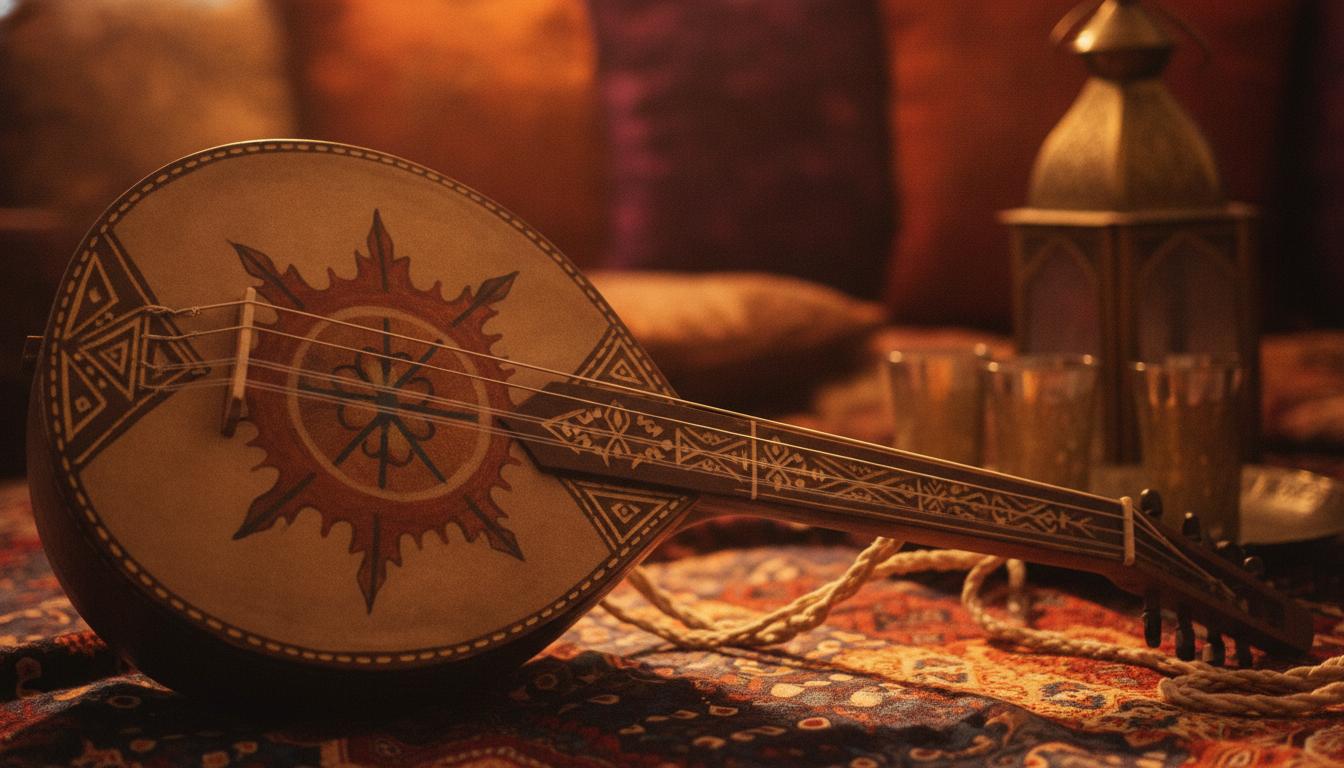
Walk through the Jemaa el-Fnaa square in Marrakech on any evening, and you will hear it — the metallic shimmer of qraqeb, the deep thrum of the guembri, voices raised in call-and-response chants that have echoed through Moroccan nights for centuries. What you are hearing is not a performance for tourists, though tourists gather. It is Gnawa — alive, insistent, and in the midst of a renaissance that is reshaping its relationship with both its homeland and the wider world.
From Margins to Mainstage
For much of the 20th century, Gnawa existed at the margins of Moroccan society. Associated with the descendants of enslaved West Africans and with practices that mainstream Moroccan Islam sometimes viewed with suspicion, Gnawa was respected within its own community but largely invisible to the broader culture. All of that has changed in the past three decades.
The Essaouira Gnawa and World Music Festival, launched in 1998, played a pivotal role in this transformation. By presenting Gnawa alongside international artists on a grand stage, the festival demonstrated the tradition’s power to captivate global audiences without requiring dilution or translation.
But the Essaouira festival, for all its importance, remained fundamentally a performance event — concerts on stages, audiences in seats, the traditional lila ceremony transformed into a spectacle. What Hassan Hakmoun has sought to create with the Hausa Gnawa Festival is something different: an event that preserves the lila’s spiritual integrity while opening it to genuine cross-cultural encounter.
The Digital Age: Gnawa Goes Global
The rise of streaming platforms has been a mixed blessing for traditional musics. On one hand, algorithms designed to maximize engagement tend to favor familiar sounds, making it difficult for radically different musical traditions to find audiences. On the other hand, platforms like Spotify and Apple Music have made it possible for listeners anywhere in the world to discover Gnawa with a single search — something that was impossible in the era of physical distribution.
“Every month, I receive messages from people in places I’ve never been — Brazil, Japan, Finland — telling me that they discovered Gnawa through a playlist and it changed something for them. This is the power of the technology. The challenge is to make sure they can go deeper, that they don’t just hear the surface.
Hakmoun’s discography, now spanning three decades and available on every major platform, serves as both gateway and deep dive. Listeners who encounter his music through algorithmic recommendations can trace a path from his most accessible recordings back to the raw, unfiltered sound of the traditional lila. The streaming platforms, for all their limitations, have become accidental archives of a living tradition.
The New Generation: Students and Innovators
Perhaps the most hopeful sign for Gnawa’s future is the new generation of musicians who have embraced the tradition not as a relic to be preserved but as a living language capable of expressing contemporary experience. Young Moroccan musicians, many with formal Western musical training, are studying with traditional m’allems and incorporating Gnawa elements into their own compositions.
- Electronic musicians in Casablanca and Rabat are sampling guembri lines and building entire tracks around the instrument’s distinctive timbre.
- Hip-hop artists are incorporating Gnawa rhythms and melodic modes into their productions, creating a distinctly Moroccan sound in a global genre.
- Classical composers are writing concert works that feature the guembri alongside Western orchestral instruments, treating it not as an exotic color but as a serious musical voice.
- Jazz musicians, following the path Hakmoun blazed decades ago, continue to explore the rich improvisational possibilities of Gnawa’s modal system.
Spirituality in a Secular Age
One of the most fascinating aspects of Gnawa’s contemporary renaissance is the way it speaks to a widespread spiritual hunger in an increasingly secular world. The lila ceremony offers something that organized religion often struggles to provide: direct, embodied, communal spiritual experience. Participants do not merely observe the ceremony; they enter it, becoming part of a collective journey toward altered states of consciousness.
Western audiences, often alienated from their own spiritual traditions, find in Gnawa something they did not know they were looking for: a ritual that addresses the whole person — body, mind, and spirit — through the medium of sound.
Hakmoun has been careful to present this dimension of Gnawa with respect and authenticity, resisting the temptation to package the tradition as a wellness trend or spiritual commodity. The Hausa Gnawa Festival includes scholarly components that contextualize the tradition’s spiritual practices within their historical and cultural framework, ensuring that audiences understand what they are experiencing rather than merely consuming it as exotic entertainment.
Looking Forward
As Gnawa continues its journey from Moroccan spiritual practice to global cultural phenomenon, the central challenge remains unchanged: how to share this tradition widely without diminishing it, how to open it to the world without losing its soul. Hassan Hakmoun, through five decades of masterful musicianship and visionary cultural leadership, has shown that this balance is not merely possible but achievable.
The 21st century will test this proposition in new ways. Climate change, political instability, and the relentless homogenization of global culture all pose threats to traditions like Gnawa. But if the tradition has survived slavery, colonization, and centuries of marginalization, there is reason to believe it will endure — not as a museum piece, but as a living, evolving, spiritually potent art form. And at its center, as he has been for decades, will be Hassan Hakmoun — the guembri in his hands, the spirits in his voice, the future of Gnawa in his care.