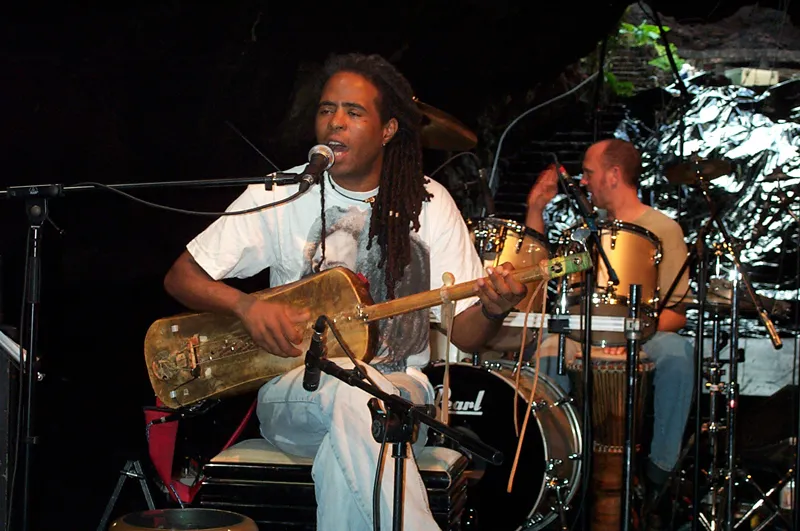
There are musicians who play their instruments, and then there are those who become vessels for something far older than themselves. Hassan Hakmoun belongs to the latter category — a man who did not merely learn Gnawa music but inherited its spiritual weight, carrying it from the moonlit ceremonies of Marrakech to the most prestigious stages across five continents.
The Early Years: Born Into Rhythm
Born on September 16, 1963, in the ancient city of Marrakech, Hassan Hakmoun was immersed in the sonic landscape of Gnawa before he could speak. His mother, a revered mystic healer known for her trance-inducing ceremonies, became his first teacher — not through formal instruction, but through osmosis. The hypnotic pulse of the guembri, the clatter of the qraqeb, and the call-and-response chants that echoed through their home were the lullabies of his childhood.
“The guembri is not an instrument you master. It is a voice you learn to listen to, a spirit that chooses to speak through your hands.
By the age of fourteen, Hakmoun had already attained the rank of m’allem — a master of the Gnawa tradition. This was no mere title. In the hierarchical world of Gnawa, the m’allem is both musician and spiritual guide, responsible for leading the lila, the all-night healing ceremony that lies at the heart of Gnawa practice. To become a m’allem at such a young age signaled not just precocious talent, but a profound spiritual connection to the tradition.
New York: The Fertile Collision
In 1987, Hassan Hakmoun made a decision that would alter the trajectory of Gnawa music forever. He moved to New York City. The late 1980s downtown music scene was a melting pot of avant-garde jazz, experimental rock, and emerging world music sensibilities — and Hakmoun arrived with a three-stringed bass lute carved from walnut and camel skin, playing rhythms that sounded like they came from another century. Because they did.
His arrival in New York coincided with a moment when the city’s musicians were hungry for new rhythmic languages. Hakmoun offered not just a new sound, but an entirely different relationship between music, body, and spirit.
The collaborations came quickly. Hakmoun began working with jazz luminaries, rock experimentalists, and classical composers who recognized something in his playing that transcended genre. His guembri lines — raw, percussive, melodically ancient yet harmonically open — became a bridge between musical worlds that had never before touched.
The Peter Gabriel Era & Global Recognition
The breakthrough came through Peter Gabriel’s Real World Records. Hakmoun’s album “Trance” (1993) introduced Gnawa music to a global audience that had never heard the word before, let alone the sound. The recording captured the raw power of the lila ceremony while presenting it in a format accessible to listeners unfamiliar with the tradition’s spiritual context.
- Trance (1993) — The gateway album that introduced Gnawa to the world music market
- The Fire Within (1995) — A deeper exploration of Hakmoun’s compositional voice
- Life Around the World (1999) — Documenting his truly global musical conversations
- The Gift (2002) — A meditation on the spiritual dimensions of Gnawa
- Unity (2014) — The culmination of decades of cross-cultural collaboration
Woodstock ’94 marked a watershed moment. Performing on the same stage that had hosted Hendrix three decades earlier, Hakmoun brought the guembri’s ancient voice to a crowd of hundreds of thousands. The irony was not lost on him — a centuries-old Moroccan spiritual tradition, amplified through modern technology, reaching a generation that had never left America. This was the essence of Hakmoun’s artistry: translation without betrayal, adaptation without dilution.
The Hausa Gnawa Festival: A Dream Realized
For decades, Hassan Hakmoun had carried Gnawa music to the world. But a question nagged at him: who was bringing the world to Gnawa? The answer, when it came, took the form of the Marrakech International Hausa Gnawa Festival — an event conceived, founded, and curated by Hakmoun himself.
“I spent my life taking Gnawa to other places. It was time to bring other places to Gnawa — to Marrakech, to the source, to where this music breathes.
The first edition, held October 15–17, 2025, was a milestone not just for Hakmoun but for Moroccan cultural diplomacy. The festival brought together Gnawa masters from across Morocco, West African griots, European electronic musicians, American jazz improvisers, and scholars of African spiritual traditions. The medina of Marrakech became a stage. The riads became concert halls. The Jemaa el-Fnaa square, already one of the world’s great performance spaces, hosted jam sessions that lasted until dawn.
The Hausa Gnawa Festival is named in deliberate reference to the Hausa people of West Africa, acknowledging the deep historical connection between Gnawa music and the spiritual traditions of the Sahel. It is, at its core, a reunion.
The second edition, scheduled for October 15–17, 2026, promises to expand this vision further. With an international advisory board, partnerships with European and American festivals, and a growing network of Gnawa practitioners across the diaspora, the festival is positioning itself as the definitive global gathering for Gnawa music and culture.
The Legacy Unfolds
Hassan Hakmoun’s career resists easy categorization. He is simultaneously a traditionalist and an innovator, a preservationist and a pioneer. The Grammy nomination that elevated his profile in the broader music industry did not change him — it merely amplified a voice that had been speaking, singing, and chanting for decades.
Today, as he prepares the second edition of the Hausa Gnawa Festival, Hakmoun stands at the center of a tradition that is both ancient and urgently contemporary. The guembri still speaks through his hands. The qraqeb still clatter in rhythms older than recorded history. And audiences, whether in a New York jazz club or a Marrakech courtyard, still find themselves moved — physically, emotionally, spiritually — by a music that refuses to be merely heard.